

Are you an entrepreneur fighting food insecurity in Nairobi, a researcher working on healthcare equity in Mumbai or a young professional feeling the weight of the world’s complexity? The application window for the 2026 cohort of Dalai Lama Fellows Programme Is open and runs from October 1 to November 12, 2025.
The Dalai Lama Fellows Programme is an immersive, year-long commitment designed to cultivate the changemaker’s inner life first. It emphasises self-awareness, emotional intelligence, and genuine compassion as the true engines for global transformation. It seeks only 15 to 20 exceptional individuals worldwide for the 2026 cohort. The competition is rigorous, but for those who understand the programme’s unique focus on contemplative leadership.
About the Dalai Lama Fellows Programme
The Dalai Lama Fellows Programme (DLF) was founded in 2010 with the direct encouragement and inspiration of the 14th Dalai Lama. Its mission is to cultivate and support an international movement of young change-makers who are ready to meet global challenges in locally adapted ways, promoting the flourishing of our planet.
The initiative embraces a distinctive “Head, Heart, and Hands” leadership model, holding that self-awareness, emotional intelligence, compassion, and resilience are necessary skills for responding to complex global challenges.
It is unique in supporting the well-being of changemakers themselves and the social, emotional, and intercultural skills needed for their work to have a truly transformative impact. The goal is to help Fellows flourish and see their own transformation ripple out to their teams, communities, and embedded systems.
As Anurodh Sachdeva, a 2017 Fellow from India, summarised: “Dalai Lama Fellows is a unique experience. It is not a curriculum; it is a journey, a journey of self-exploration, faith, and hope. It augments your faith in humanity and crafts a new definition of leadership for you which is based on the most basic values of humanity….”
Emphasis on Contemplative Practice
The Dalai Lama Fellowship stresses inner work because it’s deeply rooted in the history of learning. Historically, universities developed from monastic settings where contemplation was considered critical to learning. However, the Enlightenment and scientific revolution led to a strong bias toward logic and science, often sacrificing the knowledge of our inner lives.
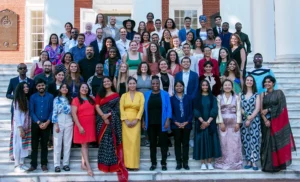

DLF focuses on reorienting what we value in education, striving to allow students to “feel deeply and experience themselves within their education”. This approach presumes that capacities like sustained voluntary attention, emotional balance, insight, and compassion are able to be developed through practice.
Is DLF religious?
No. The Dalai Lama Fellows is a non-sectarian and inclusive programme. The curriculum presents ideas and practices from many of the world’s diverse wisdom traditions, and they do not privilege any one over others. Fellows are even encouraged to connect with the wisdom and practices of their own cultures and traditions.
The Core Curriculum
The year-long curriculum is delivered via an online learning platform and aims to build three core competencies:
- Connections to Self (Head): Focuses on the individual innovator, helping deepen self-awareness, emotional intelligence, resilience, and self-care practices.
- Connections to Others (Heart): Focuses on relationships, strengthening the ability to form meaningful connections, even when differences exist.
- Connections to Ecosystems (Hands): Focuses on the complex, interconnected systems in which we are all embedded.
The project is a necessary component for deep learning, allowing you to apply curriculum lessons to real-world challenges through application and embodied experience.
Focus Areas
DLF seeks social innovators working on projects that address complex needs in these vital areas:
- Health and Well-being
- Education
- Environmental Sustainability
- Cultural Understanding
- Human Rights
- Social Justice
- Contemplation
- Funding/Benefits
Benefits of Dalai Lama Fellowship
- Fellows receive the distinctive year-long Head, Heart, Hands online leadership curriculum.
- You get one-on-one and small-group coaching tailored to your personal development and leadership goals.
- Participation in the mandatory 5-day Assembly in May 2026 is required. The DLF covers all costs for travel, lodging, and meals for this Assembly.
- Upon conclusion in March 2027, Fellows enter the Lifelong Fellows global leadership and learning community.
Important note on Project Funding
Based on a decade of programming, DLF has found that the curriculum, coaching, and global community are the most meaningful elements they provide. While DLF won’t provide research grants, your programme coach can serve as a guide in helping you search for and develop other creative sources of project funding.
Eligibility
The DLF is looking for young people committed to personal growth in service of making the world a better place.
Requirement Details
Age – Applicant must be 20–36 years old as of April 1, 2026. If you are outside this range, they are unable to accept applications.
Language – Fluency in both written and spoken English is required.
Education Status – Educational status does not matter. Applicants can be enrolled in undergraduate or graduate studies, or not at all.
Project Status – You must demonstrate current engagement or have well-articulated plans for a social change project and sustain that engagement throughout the year. Preference is given to ongoing projects due to the difficulty of launching from scratch, but new projects are selected if plans are concrete and supported by adequate expertise and resources.
Project Launch Timeline – If you do not have an ongoing project, you are expected to launch it within the first 6 months of the fellowship.
Community Knowledge – You must have in-depth knowledge of the community and issue, preferably with at least one year of previous experience. Fellows must demonstrate at least six months of experience.
Proximity to Project – You must maintain meaningful, consistent, and immersive engagement. DLF highly prefers Fellows who are living in close proximity. If you live elsewhere, you must explicitly prove in your application how you will maintain engagement.
Contemplative Interest – Commitment to a daily contemplative practice and genuine interest in learning and engaging in contemplative practices throughout the year is mandatory.
Time Commitment – You must set aside about 12 hours per month to engage in all required aspects of the programme (readings, calls, coaching). This is in addition to time spent on your project.
Team Applicants – A group of team members may not be selected together, as DLF prioritises the individual Fellow’s learning.
Host Institutions
The Dalai Lama Fellows programme is delivered as a global community network with headquartered at the University of Virginia Contemplative Sciences Center. It’s programme is delivered in partnership with the University of Virginia, Stanford University, and the University of Colorado Boulder (CU Boulder).
Duration
The formal fellowship year spans 12 months, commencing in April 2026 and concluding in March 2027. The mandatory 5-day Contemplative Leadership Assembly takes place in May 2026.
Application Process
The 2026 application seeks 15–20 changemakers. The process involves two stages:
The General Application
The initial application consists of five primary components:
- Applicant background and overview
- Short essay questions
- Video submission
- Resume/CV
- Letter of recommendation
The Skype Interview
Candidates selected from Stage 1 are invited to a Skype interview. This is where you reaffirm what you wrote in your essays and demonstrate the depth of your personal commitment.
Evaluation
The evaluation prioritises the individual’s personal transformations and leadership practices as intertwined with the transformations they seek to foster in the world. Therefore, evaluating applicants’ intentions and commitments is just as important as the strength of their project proposals.
The committee is looking for genuine intention to learn practices and perspectives that will:
- Increase self-awareness, emotional intelligence, and resilience.
- Expand their ability to connect with others in compassionate ways, even when there are differences.
- Deepen their capacity to navigate complex and interconnected systems in their social innovation work.
Fellows must also have a well-researched justification for the issue they are choosing to engage with and show they are deeply familiar with their community.
Deadline
- The application period for the 2026 cohort runs from October 1 to November 12, 2025.
- Deadline to Request Connection to a Lifelong Fellow is October 29, 2025
- Application Deadline is November 12, 2025
- Fellows Selection & Notification will be February 2026 Virtual
- Onboarding will be March 2026
Required Docs
The Stage 1 application requires five core components:
- Applicant background and overview
- Short essay questions
- Video submission
- Resume/CV
- Letter of recommendation
Strategies for Competitive Dalai Lama Fellows Application
We drew on the experiences of past Fellows, including Roseline Adewuyi and Damilola Fasoranti from Nigeria, who shared critical guidance.
-
Master the Essays on Why Dalai Lama Fellows Programme
You need to clearly and concisely respect the word or time limits for each question.
The Vision (Why Dalai Lama Fellows Programme)
Choose an issue you are genuinely passionate about that resonates with DLF’s aim of applying universal values. Buttress your points with a researched justification, showing the problem’s global context before streamlining it to your community’s needs.
The Intent (The ‘You’)
This is highly personal. Roseline, for instance, focused on needing improved knowledge to be a better implementer and understanding differences better by meeting global leaders. Channel your response toward how the DLF programme will specifically help you scale up your social project. You have to highlight qualities and skills you will cultivate in alignment with your personal leadership journey. Vague responses won’t fly; share the stage in your personal growth where you currently are and how the program can help you become better. Study the Head, Heart, and Hands curriculum so you can weave your answers around it.
-
Prove Your Community Roots are Deep
DLF is looking for leaders with established connections, not just great ideas.
Be Location-Specific
Clearly state the name of the community. Damilola, for example, cited Afon Community, Kwara State, Nigeria.
Show Proof of Need
You must show that the project is a genuine need, explaining practically how you discovered this through observations or prior work.
Demonstrate Experience
You need to show prior relationship and contact with community members. DLF values stakeholder involvement, so prove you know the community well enough to easily access those instrumental to your project’s success. Remember, you must demonstrate at least six months of experience with the community.
-
Navigate the Interview with Sincerity
The interview is serious
As Roseline noted, it was one of the most engaging interviews she’s had, with questions that were “really intellectually deep”.
Own Your Story
For the video submission (maximum 3 minutes), be authentic. Tell your story convincingly and speak from the heart, almost like you’re speaking to a friend, but maintain professionalism.
Be Prepared to Ponder
At the Skype interview stage, you will reaffirm what you wrote in your essays. You might even be given an excerpt from a book to read beforehand—you must understand it thoroughly, perhaps by discussing it with someone else.
Sincerity Wins
The best way to succeed is to be truthful and sincere with your responses. You have to convince the interviewer that you are outstanding enough to represent your country and are ready to apply the Head, Heart, and Hands curriculum.
Success Stories
From 2010 to 2018, DLF selected more than 150 young leaders representing more than 40 nationalities, who collectively impacted more than 1,000,000 individuals worldwide.
- Stephen Ogweno (Kenya) – His organisation, Stowelink, is youth-led and uses arts and technology (including the mobile app NCD 365) to provide healthcare resources for noncommunicable diseases (NCDs) and gender-based violence.
- Roseline Adewuyi (Nigeria) – Roseline established STEMFILLES, which provides training to young girls to embrace STEM (Science, Technology, Engineering, and Mathematics) and works to eradicate social biases that prevent them from entering these fields.
- Bhagya Wijayawardane (Sri Lanka) – Bhagya’s project, Anybody Can Grow, works to create equitable and safe food systems by providing community members with access to garden space and healthy food, alongside educational programmes.
- Abinash Mohanty (India) – His innovative project, Anwesha, focused on the Tanga community, helping traditional horse cart drivers harvest manure from their horses to generate electricity for their homes.
Official Link
For the most accurate and up-to-date information, to register for live info sessions (Oct 17 and Oct 28, 2025), and to access the application portal, please visit the official Dalai Lama Fellows website.
Apply — DALAI LAMA FELLOWS. (n.d.). In Dalai Lama Fellows. Retrieved [date you accessed], from https://www.dalailamafellows.com/apply
References
- Barratt, C. (2014). Being present in learning and teaching: Exploring the potential of contemplative pedagogy in higher education [Presentation]. Contemplative Pedagogy Network. Retrieved from https://contemplativepedagogynetwork.com/wp-content/uploads/2016/07/barratt-final-lecture-for-germany-no-notes.pdf Contemplative Pedagogy Network
- DALAI LAMA FELLOWS. (n.d.). In Dalai Lama Fellows. Retrieved [date you accessed], from https://www.dalailamafellows.com/ DALAI LAMA FELLOWS
- Dalai Lama Fellows: Welcome (n.d.). In Dalai Lama Fellows. Retrieved [date you accessed], from https://www.dalailamafellows.com/ (or relevant “Welcome” subpage) DALAI LAMA FELLOWS+1
- Impact Report – Dalai Lama Fellows. (n.d.). Retrieved [date you accessed], from [insert URL to the impact report]
(If the report is hosted on the Dalai Lama Fellows site, you might find it via their site or a PDF link; I could not locate it in the searches I ran.) - Leadership Lessons from the Dalai Lama. (2024, April 23). Leeds School of Business / CU Boulder. Retrieved [date you accessed], from https://www.colorado.edu/business/news/2024/04/23/leadership-lessions-dalai-lama University of Colorado Boulder
- Tips for applying to the Dalai Lama Fellowship Program for Emerging Leaders – Alumni share experiences! (2018, December 10). Opportunity Desk. Retrieved [date you accessed], from https://opportunitydesk.org/2018/12/10/tips-for-applying-to-the-dalai-lama-fellowship/
Contact
This fellowship is a powerful opportunity to train your mind to respond to global complexity with courage. If you have specific questions about the fellowship, including whether your project idea fits the scope, or if you want to connect to a past Lifelong Fellow, you can email the DLF team via this email: dalailamafellows@virginia.edu.