
The Rebecca Rhodes African Inclusive Literacy Research Grant funding opportunity is now open to eligible African researchers and partner NGOs working on literacy and disability inclusion. Jointly administered by the Association for the Development of Education in Africa (ADEA) and the Comparative and International Education Society (CIES), this grant supports locally led research into how…
Rebecca Rhodes African Inclusive Literacy Research Grant Funding Opportunity for African NGOs (2026 Call for Proposals)
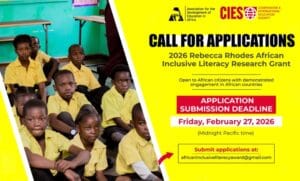
The Rebecca Rhodes African Inclusive Literacy Research Grant funding opportunity is now open to eligible African researchers and partner NGOs working on literacy and disability inclusion.
Jointly administered by the Association for the Development of Education in Africa (ADEA) and the Comparative and International Education Society (CIES), this grant supports locally led research into how children and young people with disabilities learn to read in African contexts.
Across much of Africa, children with disabilities remain underrepresented in early grade reading data and classroom practice. While many countries have adopted inclusive education policies, implementation gaps persist at school level.
With a firm deadline of 27 February 2026, this call for proposals targets scholars and practitioners who can link real classroom challenges to policy-relevant evidence. The award is intended for research rather than service delivery, making it particularly relevant to NGOs with strong field access and qualified research partners.
Discover 19 Grants Closing in February 2026
Grant Overview
The Rebecca Rhodes African Inclusive Literacy Research Grant was established in memory of Rebecca H. Rhodes, a recognised advocate for equitable access to books and literacy instruction for marginalised learners.
The grant is delivered through a partnership between ADEA, a pan-African education poli
cy platform, and CIES, an international research association specialising in comparative and international education.
The purpose of this grant is to strengthen the evidence base on inclusive literacy in African education systems. Despite policy commitments to inclusive schooling, children with disabilities continue to face barriers to acquiring foundational reading skills.
This funding opportunity supports African-led research that explains why these barriers persist and identifies practical, scalable responses grounded in local realities.
The grant’s broad objectives are to:
- Support African researchers studying literacy and disability inclusion
- Generate evidence that informs education policy and classroom practice
- Promote research rooted in real school and community settings
- Improve understanding of accessible reading systems and materials
Key Grant Details
- Funder: Association for the Development of Education in Africa (ADEA) and Comparative and International Education Society (CIES)
- Grant amount: USD 5,000 (single research award)
- Eligible applicants: African researchers and practitioners (including NGO-based researchers)
- Eligible regions: African countries, with preference for West, East, Central, and Southern Africa
- Deadline: 27 February 2026 (midnight Pacific Time)
- Project duration: Up to 18 months (completion by October 2027)
Who Is Eligible to Apply?
This call is structured to ensure African leadership in inclusive literacy research. Although NGOs may act as host or partner institutions, the grant is awarded to an individual Principal Investigator (PI).
Eligible applicant profiles include:
- NGO practitioners engaged in education or disability research
- University-based researchers
- Civil servants or education officers with research mandates
- Independent researchers with demonstrated field access
Academic and residency requirements:
- The lead applicant must be a citizen of an African country
- The applicant must currently reside in Africa or show recent residence with intent to remain during the research period
- The applicant must hold at least a Master’s degree and have commenced a Doctoral programme
- The applicant must serve as Principal Investigator
Geographic scope:
- Research must be conducted in an African country
- Preference is given to under-researched or underserved regions
For NGOs, this means the organisation cannot apply alone unless a staff member or partner meets these academic criteria and formally leads the study.
What the Grant Supports
The grant supports research that links literacy development with disability inclusion. Disabilities may include physical, sensory, cognitive, or learning impairments.
Priority research areas include:
- Foundational literacy skills: How children with disabilities acquire decoding and comprehension skills
- Instructional adaptations: Use of Universal Design for Learning (UDL) in low-resource classrooms
- Accessible materials: Availability and effectiveness of braille, large-print, and decodable texts in African languages
- Policy-to-practice gaps: Why inclusive education policies stall at school level and how communities respond
Typical activities supported:
- Classroom observations
- Literacy assessments
- Interviews with teachers, parents, and learners
- Analysis of teaching materials and book supply systems
- Local travel and data collection costs
Activities not supported:
- Service delivery projects
- Infrastructure or construction
- Routine NGO operating costs
The grant is strictly intended for research that contributes to knowledge on inclusive literacy.
How to Apply
Applications must be submitted by email as a single file.
Application stages:
- Develop a research proposal (maximum 2,000 words)
- Compile all required supporting documents
- Submit by email before the deadline
- Await jury review and award notification
Authoritative application channel: africaninclusiveliteracyaward@gmail.com
This email address is the official and verified submission route for this grant.
For more information, check out the 2026 Rebecca Rhodes African Inclusive Literacy Research Grant
Detailed Application Instructions
Applications must be submitted as one PDF or Word document in English or French and contain two main parts.
Part I: Research Proposal (maximum 2,000 words)
The proposal must include:
- Title and abstract – A concise summary of the research focus
- Problem statement – Data-based explanation of the literacy barrier under study
- Research questions – Two or three clearly defined questions
- Methodology
-
Study design (qualitative, quantitative, or mixed methods)
-
Sampling strategy
-
Data collection tools
-
-
Ethical considerations
-
Proof of submission to an Institutional Review Board (IRB) or local ethics committee
-
-
Potential impact
-
How findings will influence policy, teaching, or community practice
-
Supporting Documents
- Itemised budget
- Applicant’s curriculum vitae
- Timeline or workplan (18 months)
- At least one letter of support from a school, NGO, or university partner
These requirements are based on the official 2026 call issued by ADEA and CIES.
Evaluation and Selection Process
Applications are reviewed by experts drawn from ADEA and CIES Special Interest Groups in global literacy, inclusive education, and African education.
Scoring criteria:
- Relevance to inclusive literacy in Africa (30%)
- Methodological rigour (30%)
- Originality (20%)
- Applicant capacity (10%)
- Dissemination plan (10%)
Expert Insight
In small research grants of this kind, review panels often look first for evidence that the researcher can reach schools and learners.
A modest, well-defined study with secure access to participants is usually stronger than an ambitious national survey. NGOs supporting postgraduate researchers should ensure proposals reflect practical classroom challenges rather than abstract policy debates.
Important Notes
- Funds are released only after ethics approval is confirmed
- A mid-term report (9 months) and final report (18 months) are required
- Open-access dissemination of findings is encouraged
- Applicants should always verify details against the official call
Disclaimer: FundingOpportunitis.com does not administer this grant and does not influence selection decisions.
Frequently Asked Questions (FAQ)
Who can apply for the Rebecca Rhodes African Inclusive Literacy Research Grant funding opportunity?
African citizens with at least a Master’s degree who have begun a PhD programme and can act as Principal Investigator.
Can NGOs apply directly?
The grant is awarded to individuals, but NGOs may host or support the research if eligibility requirements are met.
What is the grant amount?
USD 5,000 as a one-time research award.
What types of projects are not eligible?
Service delivery projects, infrastructure, and routine programme costs are not supported.
Where do I submit my application?
Applications must be emailed to africaninclusiveliteracyaward@gmail.com.
Related Funding Opportunities
- Mitigation Action Facility Funding Opportunity (Call for Projects 2026) for African NGOs
- AU–EU Youth Lab Cooperation Grant – Funding Opportunity for African NGOs
- Goethe-Institut Heritage Narratives Funding Opportunity for African NGOs
- Theirworld Small Grants Programme 2026 – Funding Opportunity for African NGOs
Conclusion
The Rebecca Rhodes African Inclusive Literacy Research Grant funding opportunity provides a focused route for African researchers and partner NGOs to generate evidence that improves how children with disabilities learn to read.
With a targeted award and a strong emphasis on methodological rigour, this grant is best suited to applicants who combine academic discipline with direct field experience.
If this opportunity aligns with your work, begin preparing your documentation early and confirm your eligibility. Readers are encouraged to bookmark this listing, share it with qualified colleagues, and subscribe for alerts on similar grants for NGOs in Africa and inclusive education research.