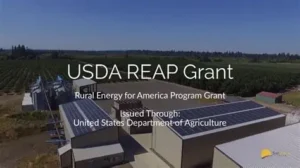
The Rural Business-Cooperative Service (RBCS) has released a Notice of Funding Opportunity (NOFO) for the Rural Energy for America Program (known as USDA REAP Grant). This announcement, published in the Federal Register on October 16, 2024, opens applications for grants, guaranteed loans, and combined grant-loan packages.
The funding opportunity covers fiscal years 2025, 2026, and 2027, with applications accepted through September 30, 2027. All submissions will be reviewed and scored based on the criteria outlined in the official notice.
The USDA REAP programme is one of the most vital sources of financial assistance available to agricultural producers and rural small businesses looking to reduce energy costs and consumption and meet the nation’s critical energy needs.
This programme offers two primary types of assistance, which are grants and loans. They are the Renewable Energy Systems and Energy Efficiency Improvements (RES/EEI) grants and loans and Energy Audit and Renewable Energy Development Assistance (EA and REDA) grants.
The funding is administered by the United States Department of Agriculture (USDA) through its Rural Business-Cooperative Service (RBCS), a Rural Development (RD) agency. This opportunity is particularly significant because the Inflation Reduction Act (IRA) of 2022 invested over $2 billion into REAP.
This historical funding represents the largest investment in clean energy in American history, and it ensures essential resources are available for rural businesses through 2031. Due to the IRA, the programme has doubled the maximum grant funding available, making this a generational opportunity for qualifying projects.
Grant Size
The collective funding for fiscal years 2025, 2026, and 2027 is anticipated to be substantial—at least $600,000,000. Approximately $180,000,000 per federal fiscal year will come from IRA funds. Also, about $20,000,000 per federal fiscal year is specifically set aside for underutilised renewable energy technology.
The most exciting financial changes stem from the IRA funds:
Grant Percentage Increase
The maximum grant funding available per project has doubled from 25% to 50% of total eligible project costs. This 50% share applies if the project is a renewable energy system or retrofit that produces zero greenhouse gas emissions at the project level, is an energy efficiency project, is located in an energy community, or is proposed by an eligible tribal entity. Other applications, such as biomass and biogas projects, are eligible for up to a 25 per cent federal grant share from IRA funds.
Maximum Grant Assistance
The maximum grant request for a Renewable Energy System (RES) project is now $1,000,000. For an Energy Efficiency Improvement (EEI) project, the maximum grant request is $500,000.
Minimum Grant Assistance
The minimum grant request at 50% funding is $5,000 for RES projects (which must have a total cost of $10,000) and $3,000 for EEI grants (which must have a total cost of $6,000).
Loan Guarantees
The maximum guaranteed loan amount provided to a borrower is $25 million. Combined grant and guaranteed loan requests cannot exceed 75 per cent of total eligible project costs.
When the up to 50 per cent REAP grant is coupled with the 30 per cent Investment Tax Credit (ITC) and depreciation benefits, many renewable energy projects can see their total costs offset by 70 to 90 per cent. That’s the real financial power of this programme.
Who Can Apply
Eligibility requirements generally apply to the project, the borrower, the lender, and the applicant.
Applicants Categories
Agricultural Producers:
This includes individuals or entities generating at least 50 per cent of their gross income from agricultural operations. This encompasses pursuits such as crops, livestock, aquaculture, forestry operations, and nurseries. Agricultural producers have more flexibility in location, as they can be located in rural or non-rural areas.
Small Businesses
These businesses must meet the Small Business Administration (SBA) definition of a small business, which considers factors such as business type, employee count, or annual receipts. Critically, small businesses must be located in eligible rural areas with populations of 50,000 or fewer. For example, in the Rogue Valley, while most of Jackson County and Josephine County qualify as rural areas, the area inside the Medford city limits does not qualify for small businesses.
Tribal Entities
Eligible tribal corporations or other tribal business entities (including tribal agriculture operations) are eligible for funding.
If you meet these criteria, you should definitely consider applying.
A note on NIH REAP: It’s important to clarify that this funding opportunity is offered by the USDA. The NIH also runs a programme called the Research Enhancement Award Program (REAP). The NIH REAP is specifically for principal investigators whose primary appointment is in a health professional school (HPS). Or graduate school at an organisation that has received no more than $6 million per year in NIH funding in 4 of the last 7 federal fiscal years. These are separate federal programmes.
Projects They Support
REAP is designed to support a wide range of projects aimed at increasing energy self-sufficiency and efficiency.
Renewable Energy Systems (RES)
Numerous types of renewable energy projects are eligible, including solar, wind, and geothermal.
Energy Efficiency Improvements (EEI)
Grants are available specifically for energy efficiency projects, not just generation.
Zero Greenhouse Gas Emissions
Projects that produce zero greenhouse gas emissions at the project level (like solar) are eligible for the maximum 50 per cent federal grant share from IRA funds.
Underutilised Technologies
The Agency sets aside approximately $20,000,000 per fiscal year for “underutilised renewable energy technology”. This is defined as technologies that do not produce greenhouse gases at the project level and made up less than 20 per cent of obligated grant dollars two years prior.
Key Priorities
The agency encourages applicants to consider projects that advance key priorities, such as assisting rural communities to recover economically, reducing climate pollution, increasing resilience to climate change impacts, and advancing racial justice, place-based equity, and opportunity.
What Proposal Must Include
The new policy landscape introduces critical requirements, particularly concerning solar installations and equipment sourcing needed for a complete and eligible application.
Technical Merit
Only projects determined by the agency to have technical merit are eligible for funding.
Ground-Mount Limits
The USDA will not support large solar farms that remove productive farmland from operation. Specifically, the agency will not fund any ground-mounted project larger than 50 kW through REAP grants or guaranteed loans. If you have a smaller ground-mounted system (50 kW or less), you must still document historical energy usage tied to the farm or facility, as speculative solar fields do not qualify.
Domestic Equipment
To strengthen U.S. supply chains, the USDA prohibits the use of solar panels manufactured by foreign adversaries in any USDA-funded project. This is a major compliance point that applicants must adhere to.
No Retail Network
RES projects that include components and ancillary infrastructure like flexible fuel pumps or electric vehicle charging stations may not be networked. Or utilise network management software that allows for payment processing, as these systems involve a mechanism for dispensing energy at retail.
Hemp Production Compliance
Any project proposing to produce, procure, supply, or market any component of the hemp plant must have a valid licence from an approved state, tribal, or federal plan and must be in compliance with Agricultural Marketing Service regulations.
Application Process
Applying for this competitive funding is a detailed process that requires careful attention to deadlines and compliance.
Consultation is Key
The agency strongly encourages applicants to contact their USDA RD state energy coordinator well in advance of the deadline. You should discuss your project and ask any questions about the application process early. Contact information for state energy coordinators is available on the USDA website.
SAM/UEI Registration
At the time of application, every applicant must have an active registration in the System for Award Management (SAM) and obtain a Unique Entity Identifier (UEI). You must maintain active SAM registration throughout the consideration period. The agency cannot make an award until you have fully complied with all SAM requirements.
Application Submission
You must submit a complete application by 4:30 p.m. local time on the submission deadline. You can submit one original hardcopy or electronic application to the appropriate RD Energy Coordinator for the state where the project will be located or submit grant applications electronically via grants.gov.
Review and Clarification
Once submitted, the agency reviews the application for completeness. If it is incomplete, the agency will notify you and provide a strict 15 business days to submit the missing documentation. If you miss this deadline, your application will be withdrawn. If the agency requires additional clarification on eligibility or financial/technical feasibility, you will receive a second 15-business-day window to provide the needed information. Many applicants overlook this strict response time, so be prepared to act fast.
Important Conditions
Risk of Incurring Costs Early
This is perhaps the most important administrative warning: costs incurred prior to the agency’s acknowledgement of a complete and eligible application are considered ineligible project costs.
Applicants are strongly advised against starting construction prior to the agency’s completion of its environmental review process. If you incur project costs or commence construction activities early, you will bear all the risk, as the project may ultimately be determined ineligible.
Aggregated Funding Limits
Entities that share common management or ownership, regardless of the percentage owned, have an aggregated funding limit of $500,000 in EEI awards and $1 million in RES awards per federal fiscal year.
Grant Limitations
Sources of REAP grant funds cannot be combined to fund a single project. Also, you can only have one active application for assistance per project regardless of fiscal year.
Disbursement Deadline
The secretary cannot enter into a loan agreement that may result in a disbursement after September 30, 2031, or a grant with an outlay after September 30, 2031. Applicants should plan their project timelines accordingly.
Federal Compliance
Awardees are subject to numerous requirements, including the Build America, Buy America Act (BABAA), the Transparency Act Reporting (FFATA), and the Civil Rights Act. For example, non-federal entities receiving funds must adhere to the BABAA requirements, ensuring that project materials are domestically sourced unless a waiver is requested.
Timeline
This NOFO establishes the grant competition schedule through fiscal year 2027.
Grant applications for RES/EEI will be accepted between July 1 and March 31 of each year covered under this notice. The Agency will not be accepting applications between April 1 and June 30 of each year; any application received during that time will be returned and not reviewed.
The specific grant competition deadlines
Fiscal Year 2025 – Complete applications must be received by December 31, 2024, and March 31, 2025.
Fiscal Year 2026 – Complete applications must be received by September 30, 2025; December 31, 2025; and March 31, 2026.
Fiscal Year 2027: Complete applications must be received by September 30, 2026; December 31, 2026; and March 31, 2027.
If a competition deadline falls on a weekend or a federally observed holiday, the deadline shifts to the next federal business day. Applications that are not funded in one competition will automatically roll over to the next one.
For EA/REDA grants, the deadline remains fixed at 4:30 p.m. local time on January 31 of each year. Guaranteed loan applications are completed on an ongoing basis.
How Proposals Are Judged
The agency uses a competitive scoring system, with a maximum total of 100 points, to rank applications and determine funding distribution. This NOFO updates the criteria for applications submitted on or after the next business day following the notice’s publication.
Two previous scoring criteria—existing business and size of request—have been officially removed from the scoring criteria.
How Core Categories are Weighed
Energy Generated, Saved, or Replaced (Up to 25 Points)
This is the single most influential category. The score depends on how much energy your renewable energy system or energy efficiency project will generate or save the electric grid from having to produce. The greater the energy impact, the more points the application receives.
Location in a Disadvantaged or Distressed Community (Up to 15 Points)
This is a newly weighted criterion. Points are awarded if any portion of the project site is located in a Disadvantaged Community (identified using the Council on Environmental Quality’s Climate and Economic Justice Screening Tool) or a Distressed Community (identified using the Economic Innovation Group’s Distressed Communities Index). The USDA wants to provide a “little boost” to rural communities struggling with economic challenges.
Previous REAP Funds (Up to 15 Points)
This is the easiest category to maximise if you are a first-time applicant. If you have never received REAP funding before (either a grant or a loan), you automatically receive all 15 points. The USDA prioritises new projects.
Length of Payback Period (Up to 15 Points)
The USDA favours projects that demonstrate financial viability quickly. The faster you can recover your investment due to reduced energy costs, the more points you receive. Projects with simple payback periods under five years have successfully won REAP funding.
Commitment of Funds (Up to 10 Points)
This category, now capped at 10 points, assesses the reliability of committed matching funds. Since the grant only covers up to 50 per cent of the cost, and the 30 per cent tax credit is received later, applicants need capital up front. Demonstrating verified matching funds strengthens the application significantly.
Environmental Benefits (Up to 10 Points)
All projects that do not produce greenhouse gas emissions at the project level (like solar) are automatically awarded five points. Up to five additional points can be earned (one point each) by meeting sub-criteria like avoiding converting farmland, documenting water conservation, or ensuring 25 per cent of project components are bio-based.
State Director and Administrator Priority Points (Up to 10 Points)
The State Director or Administrator may award up to 10 priority points based on specific criteria. A maximum of 5 points may be awarded for projects advancing racial justice and place-based equity (e.g., location in or serving a community with a Social Vulnerability Index score of 0.75 or above or being a federally recognised Tribe). An additional 5 points may be awarded based on factors like veteran ownership, ownership by a member of a socially disadvantaged group, or being in a recent federally declared major disaster area.
Tips for Competitive Proposals
Submitting a strong application requires more than just meeting the basic requirements—it demands strategic planning:
Aim High for Energy Impact
Since the Energy Generated/Saved category is worth 25 points, it is worth it to aim higher and install enough panels to shoot for 80 per cent, 90 per cent, or even 100 per cent energy replacement. Talk to a qualified solar consultant to find the “sweet spot” that maximises your REAP score while minimising liability.
Document Demand
Due to the new rules, you must gather 12 to 24 months of energy bills from your farm or facility to establish proven energy usage and properly size the system.
Prioritise Rooftop
With farmland preservation now federal policy, solar installations on barns, warehouses, and other structures will receive priority over land-intensive ground-mount projects in funding decisions.
Avoid Shared Meters
One common mistake that complicates REAP applications happens when an agricultural producer or rural small business uses the same electric meter as a residential home. The application will do better if you have separate meters.
Source American-Made
You must select an installer who sources compliant American-made components, as using panels manufactured by foreign adversaries is prohibited.
Don’t Rush
Applying for a REAP grant is complex; it’s not something to do on the weekend. If you have to rush to make the deadline, it might be better to wait until the next submission window to ensure a comprehensive, winning package.
Application Link
Programme guidance and application forms may be obtained at rd.usda.gov/programs-services/all-programs/energy-programs. Electronic grant applications can be submitted via grants.gov.
Contact Information
If you have generate questions,head over to: Jonathan Burns, Programs Management Division, RBCS, USDA. Phone: (774) 678-7238 or Email: CPgrants@usda.gov.
For state-specific questions: Applicants are encouraged to contact their USDA RD State Energy Coordinator well in advance of the deadline. Contact information for State Office Energy Coordinators is available at rd.usda.gov/files/RBS_StateEnergyCoordinators.pdf.
Commonly Asked Questions
Q: Are costs incurred before application submission eligible for reimbursement?
A: No. Costs incurred prior to the agency’s acknowledgement of a complete and eligible application are considered ineligible project costs.
Q: What is the risk of starting construction early?
A: Applicants are strongly advised against starting construction prior to the agency’s completion of its environmental review process. You bear the full risk should you incur costs or commence construction activities before receiving notification that your application is complete and eligible.
Q: Is there a limit to how many grants an entity can receive?
A: Yes. Applicants can compete for and be awarded only one RES grant and one EEI grant in a fiscal year, which includes the grant portion of a combined funding request. Furthermore, entities that share common management or ownership have an aggregated funding limit of $500,000 in EEI awards and $1 million in RES awards per Federal Fiscal Year.
Q: Can I combine REAP grant money with loan money?
A: Yes. Loan and grant combination applications may use IRA grant funds and mandatory Farm Bill loan funds to fund a project.
Q: What happens if my application is determined to be incomplete?
A: If your application does not meet the definition of complete, the Agency will notify you and give you 15 business days to provide the missing documentation before your application is withdrawn.
Key Takeaways
The USDA REAP programme, with its significant IRA backing, remains one of the strongest funding opportunities available for rural American energy projects, confirming grants are locked in through March 2027. However, the strategic changes—particularly the restriction on large ground-mount solar fields on farmland and the new mandate for domestic equipment—mean the application process is now more competitive and compliance-driven than ever.
Success hinges on meticulous preparation: documenting historical energy demand, adhering strictly to the new size limits, and maximising points in the scoring categories, especially if you are a first-time applicant. While the programme presents strict 15-business-day deadlines for clarification and the absolute risk of incurring ineligible costs if you start early, the potential reward—covering up to 80% or more of your total project costs—makes strategic effort entirely worthwhile.
Link Sources
AG Solar Solutions (n.d.). REAP Grant scoring criteria: Keys to a winning application. USDA REAP Grant. Retrieved from https://usdareapgrant.com/scoring
Rural Business-Cooperative Service. (2024, October 16). Notice of funding opportunity for the Rural Energy for America Program for Fiscal Years 2025, 2026, and 2027. Federal Register, 89(200), 83449–83457. Retrieved from https://www.grants.gov/search-results-detail/356838